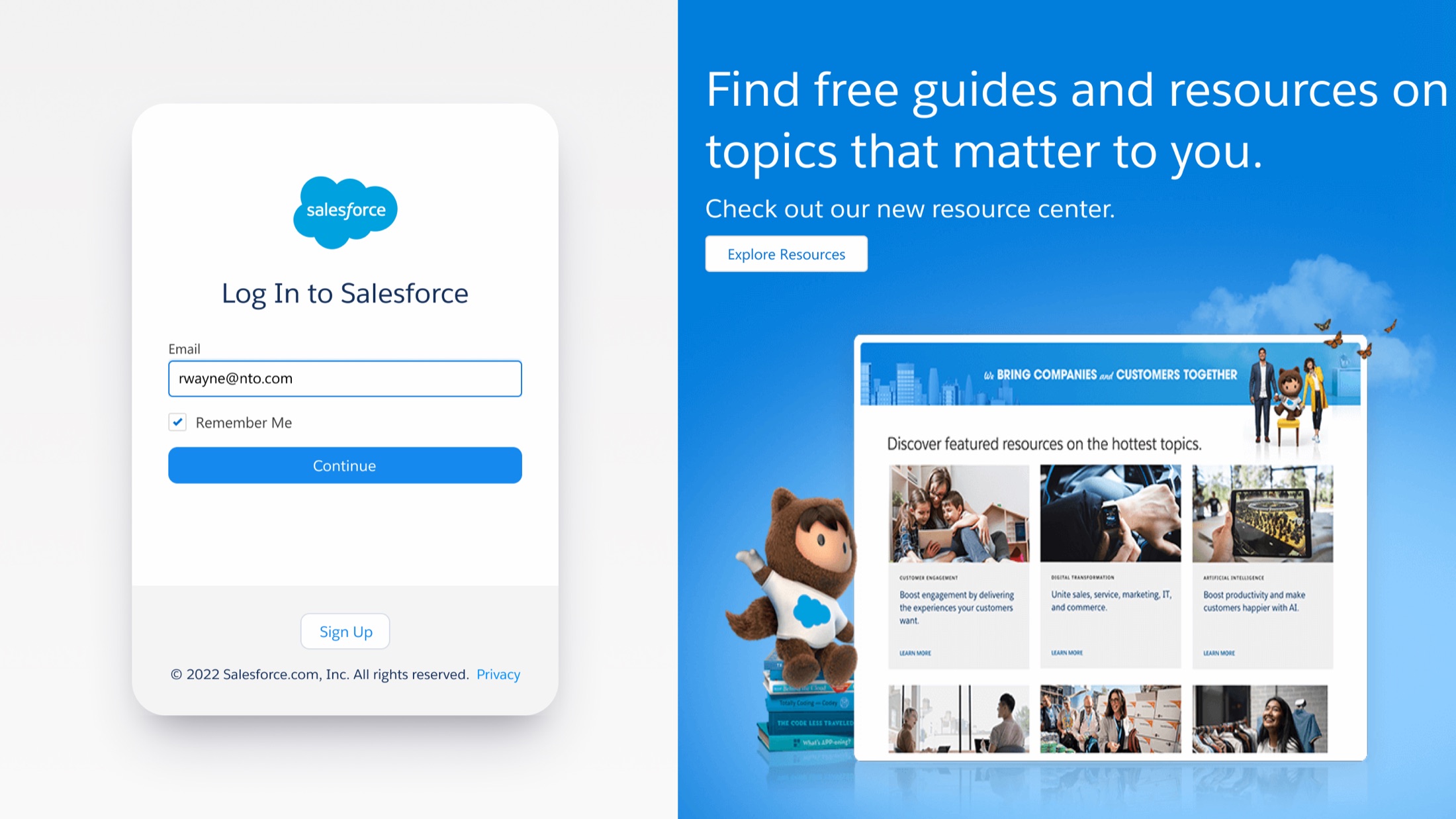
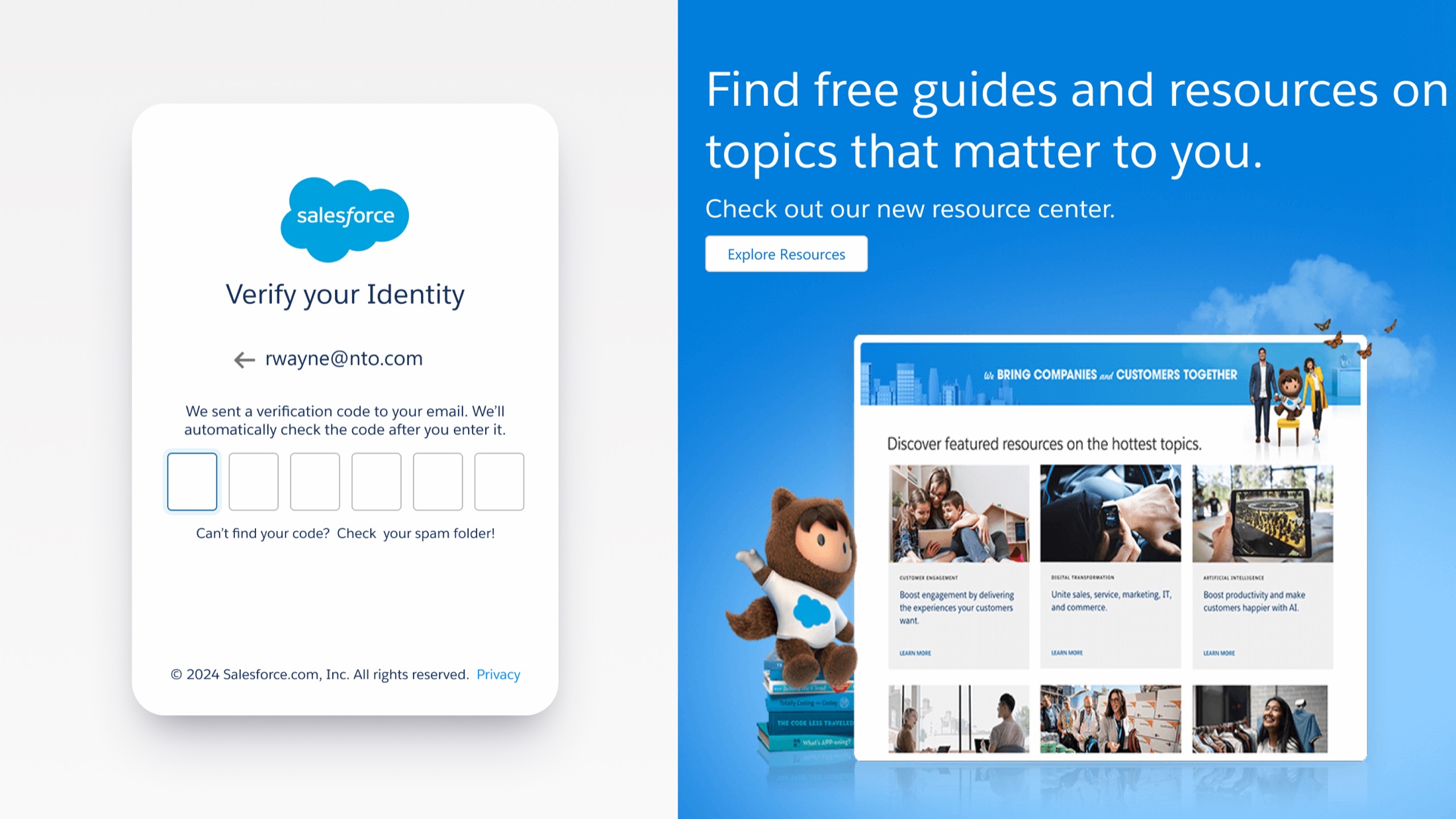
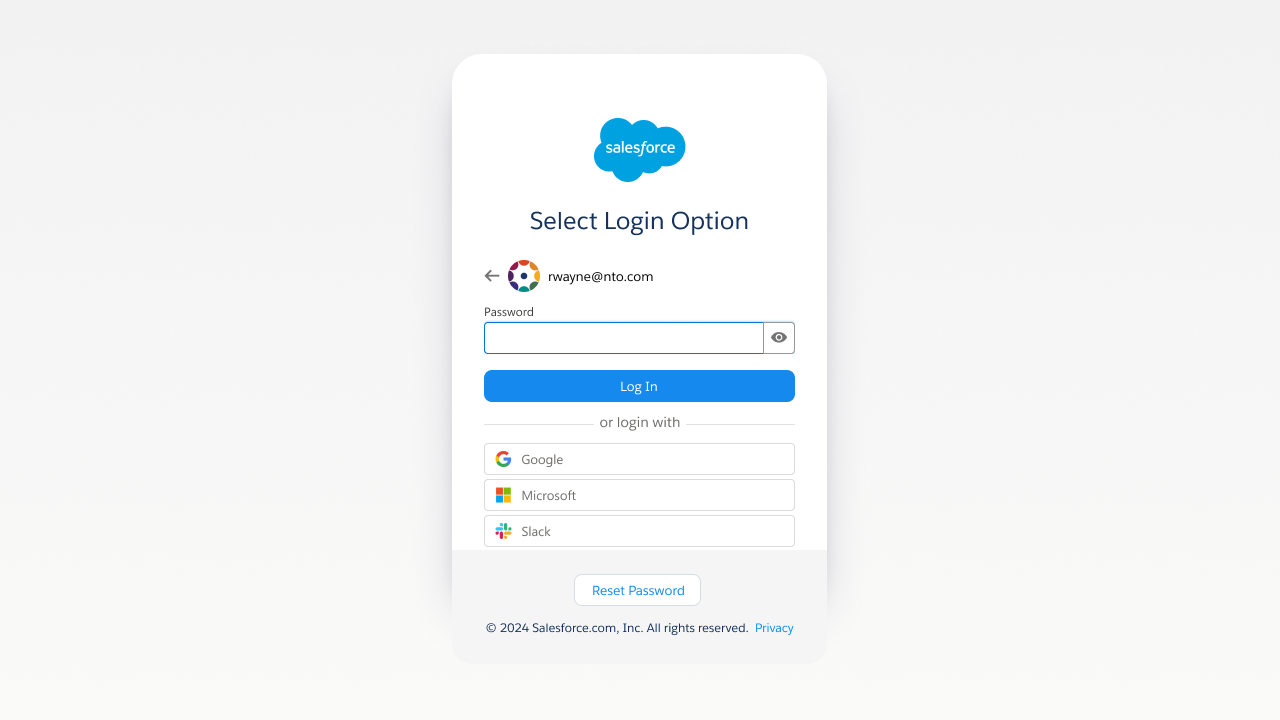
Years of acquisitions left Salesforce with a dozen different ways to log in. Each acquired product carried its own sign-in screen, its own rules, and its own idea of who the user was. I designed Welcome.Salesforce.com: a single, accessible, email-based entry point that unifies authentication across the platform and lets multi-org customers move between every environment they own from one place.
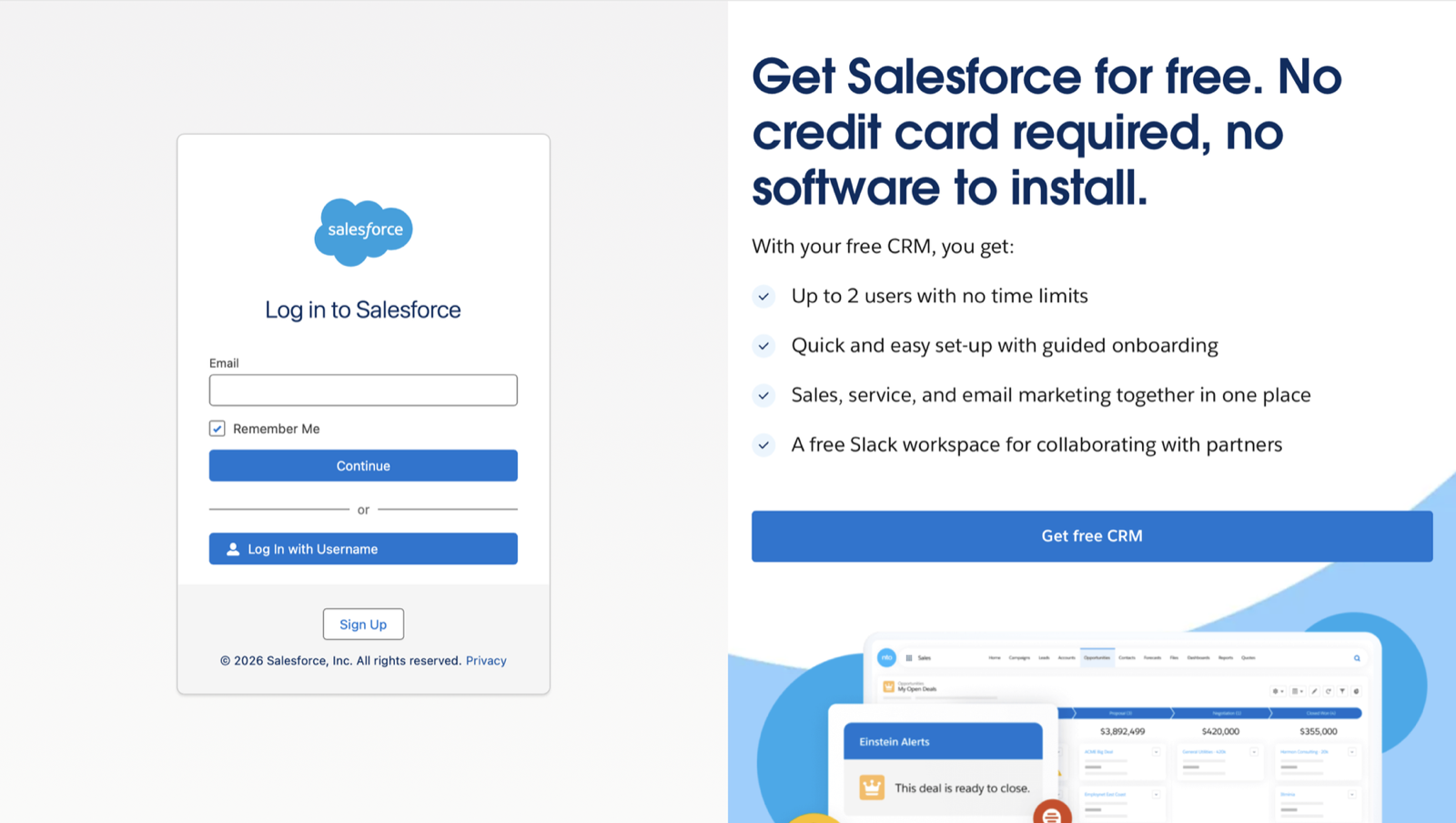
This wasn't a feature for a single cloud. It was the way everyone gets into Salesforce. I partnered closely with CX, Accessibility, Engineering, and SLDS to ship a login that's fully accessible and built entirely on the Salesforce Lightning Design System, so it feels native to the platform from the very first interaction.
As Salesforce grew through acquisition, each product arrived with its own login. The result was twelve distinct sign-in experiences: inconsistent visually, inconsistent in behavior, and confusing for the many customers who use more than one product. There was no shared identity model and no single place to land.
For multi-tenant users the friction compounded: signing out of one environment just to sign back into another, with no reliable way to tell which org they were even entering.
fragmented logins
Visually and behaviorally inconsistent. No shared identity model, no consistent place to land.
unified front door
One consistent, accessible, email-based way in for every product.
Toggle the system state: twelve inconsistent front doors become one.
The guiding question for the whole project:
How might we remove the pain and friction in our login process, so users can reach their Salesforce products quickly and start seeing value from their investment?
I started with a competitive teardown of how Microsoft, Google, Miro, and Adobe handle sign-in at scale. The patterns pointed in a clear direction: lead with email, support SSO, offer a dashboard-style way to move between products, and surface recently used products so people land where they left off.
From there I ran guerrilla research and led unmoderated usability testing, working hand in hand with accessibility partners and design critique channels to pressure-test each iteration.
I mapped the emotional arc of a multi-org login. The line tracks how confident users felt at each step, highest at the top, lowest at the bottom. Select any step to see what happened there and what it taught us.
The map revealed the real problem wasn't authentication. It was orientation, continuity, and trust across a growing ecosystem. That reframed a login redesign into a unified identity strategy: an environment switcher that surfaces each org's name, ID, and cloud type, and an email-first front door for every product.
For customers with access to several environments, the hardest moment wasn't logging in. It was choosing the right place to land. I designed an environment switcher built from tiles that surface each tenant's name, its unique identifier, and its cloud type, so the choice is obvious at a glance.
Testing sharpened the design and confirmed where users were getting lost:
The shipped MVP replaced username-based sign-in with a clean, email-first flow: enter your email, verify, and enter your password. Each step is paired with a rotating marketing panel that puts useful resources in front of users at the moment they're waiting. Multi-tenant users land in the environment switcher and move between all their orgs without ever signing out.
Identity is where I started at Salesforce, and it was a wonderful place to be for a long time. Eventually I felt the pull to explore something new, and I even started looking toward management. What I didn't realize, and only saw clearly after Agentforce Coworker, was that I had grown bored. It's funny how something can be right in front of you and stay invisible.
I had quietly started questioning whether I was still a good designer, or whether this was even my path. Then I got lucky: a hard, unfamiliar project reminded me that I love to learn, I love a challenge, and yes, I am a good designer. Identity gave me my foundation. Leaving it taught me what I am actually made for.